1st Sep 2026
ECS9: Smarter Operations, Faster Root Cause Analysis and the Future of Process ControlECS™ Update
A Platform Built for the Next Decade
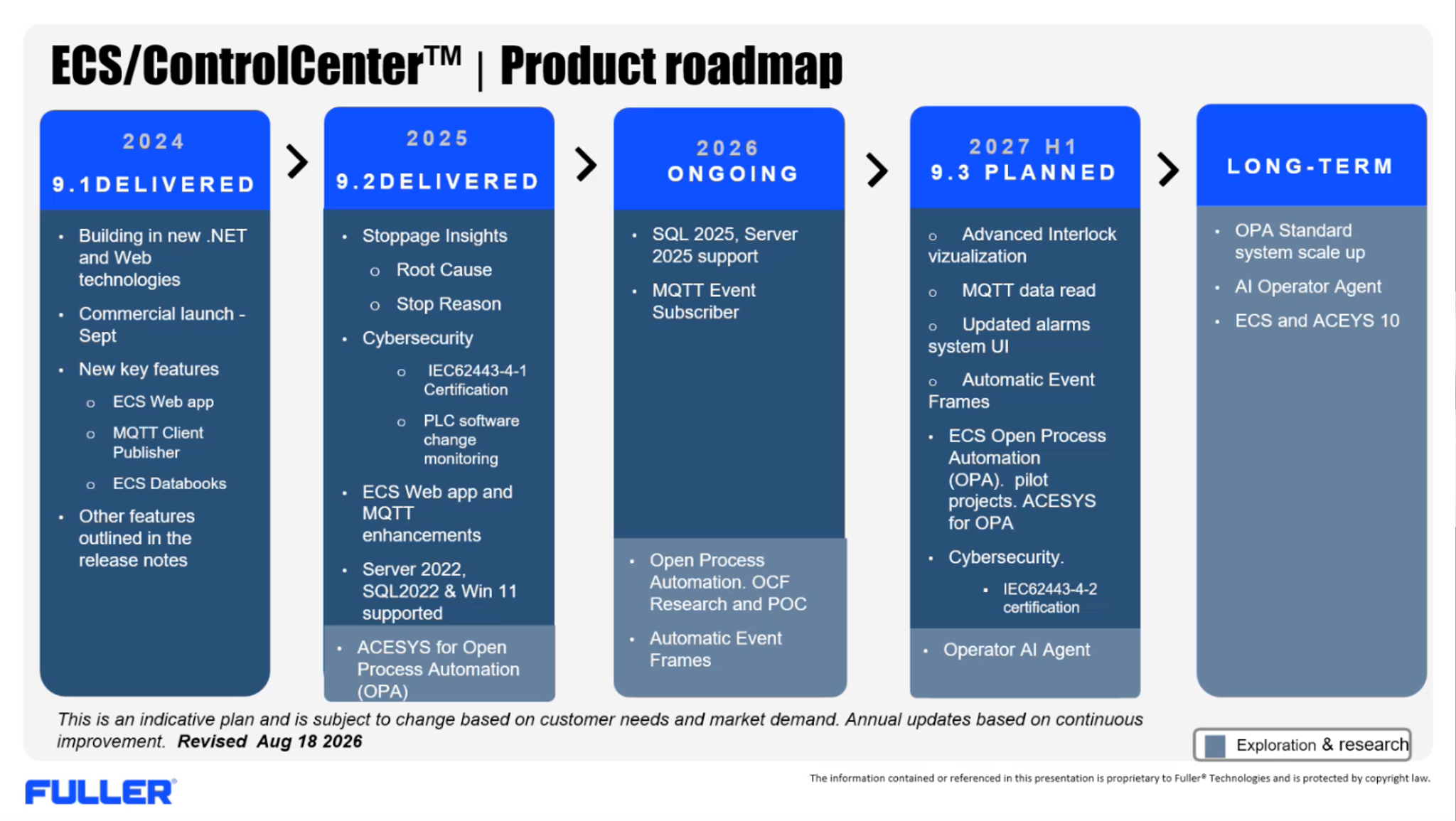
ECS has been in continuous development for 50 years, with around 2,000 systems in production worldwide. Version 9 continues that line rather than breaking it. The platform still sits on a proven stack - Windows and the .NET Framework, with the Fuller framework and core built on top - that Microsoft will support for at least another decade. What version 9 adds is a bridge: new open-source, OS-agnostic .NET technology that lets Fuller build modern web and mobile applications without disturbing the reliable core underneath.
The first application delivered across that bridge was the ECS Web App in 2024, with further ECS and QCX apps in 2027. And because the core has not changed, the move from version 8 to version 9 is a straightforward, cost-effective upgrade - the point David returns to throughout the session.
From New Capabilities to the Future of Process Control
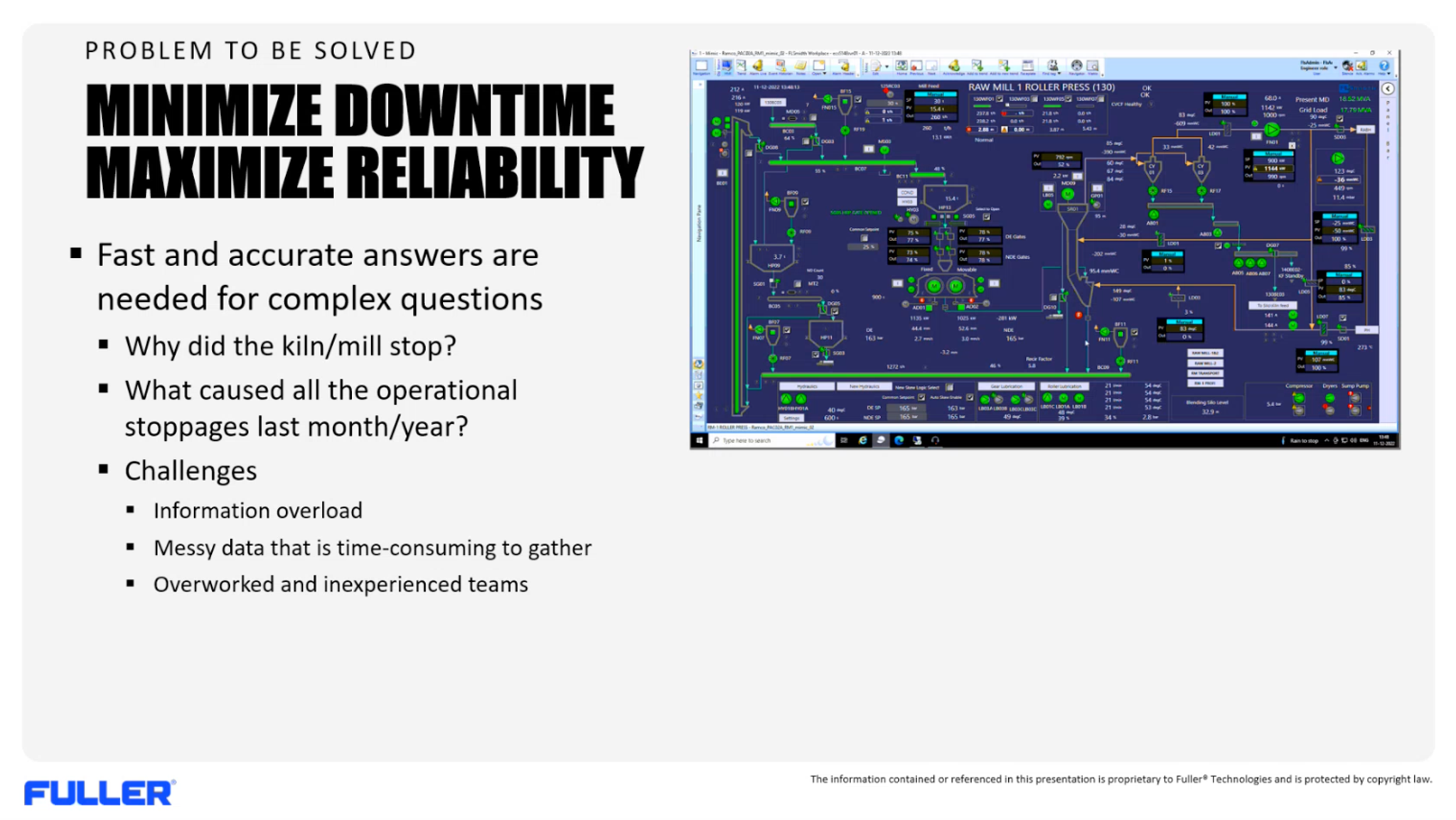
What that means in practice is already visible in the latest releases. The ECS Web App is the first application delivered on this new technology, bringing individualised plant information to any device. Our new Stoppage Insights feature draws on the richer ECS and ACESYS data for the simple-sounding but complex question behind minimising downtime and maximising reliability: why did the kiln or mill stop? It finds the root cause and stop reason of every motor stoppage automatically. Its new data model also lays the groundwork for the next step, planned with the 9.3 updates: making the relationships behind those stoppages - thousands of interlocks and startup dependencies - visible as a live, structured, machine-readable map of the plant.
The core fundamentals have not changed, but the new layer brings features that the core alone cannot achieve. The rich data model beneath these capabilities provides a solid knowledge foundation for operators and software alike - and sets the path for the future of process control with ECS: software-focused, open to any leading hardware and to the open standards ahead, grounded in your plant data. That path leads to process control that gives operators veteran-level knowledge with software assistance while staying bound by the plant's own rules. Cement producers get the newest technology without compromising reliability or security, heading into a future where the hard problems are increasingly solved by the platform.
Featured Expert:
David Campain is Product Lifecycle Manager for Process Control Systems at Fuller Technologies where he sets the direction and roadmap responsible for the ECS/ControlCenter™ and ECS/Acesys™ product lines. He began his career as a cement plant operator and brings more than 25 years across control systems engineering, customer service management, and product line leadership - experience visible in features like Stoppage Insights, built to answer the question he once had to answer himself: why did the kiln stop?
Key Insights Include:
- How Stoppage Insights automatically identifies the root cause tag, stop reason, and every affected unit for any motor stoppage - and classifies it as normal or abnormal
- Why exporting that root cause data to Excel, a CMMS, a historian, or an ERP is the raw material for a serious reliability improvement program
- How IEC 62443-4-1 certification and PLC program change monitoring answer the cybersecurity questions producers are now asking
- A first look at the Process Interlocking View coming in 2027, which maps every interlock and startup dependency in the plant - on one cement mill, 48 separate interlocks had to be satisfied before the main drive could start, nested up to 10 levels deep
- Why choosing a PLC brand is not the same as standardizing, and what Open Process Automation changes about lifecycle cost and negotiating leverage
- How the ECS Operator AI Agent moves from advisory to agentic mode - and why ACESYS interlocks make an unsafe command impossible regardless of what the model reasons
- David Campain, Global Product Lifecycle Manager for Process Control Systems, Fuller
Watch the webinar now to see Stoppage Insights and the Process Interlocking View demonstrated - and to hear the full customer Q&A on upgrade paths, PLC brands, and AI.
Keynote Insights: From Root Cause to Autonomous Operations
An Answer to “Why Did It Stop?” Every Time
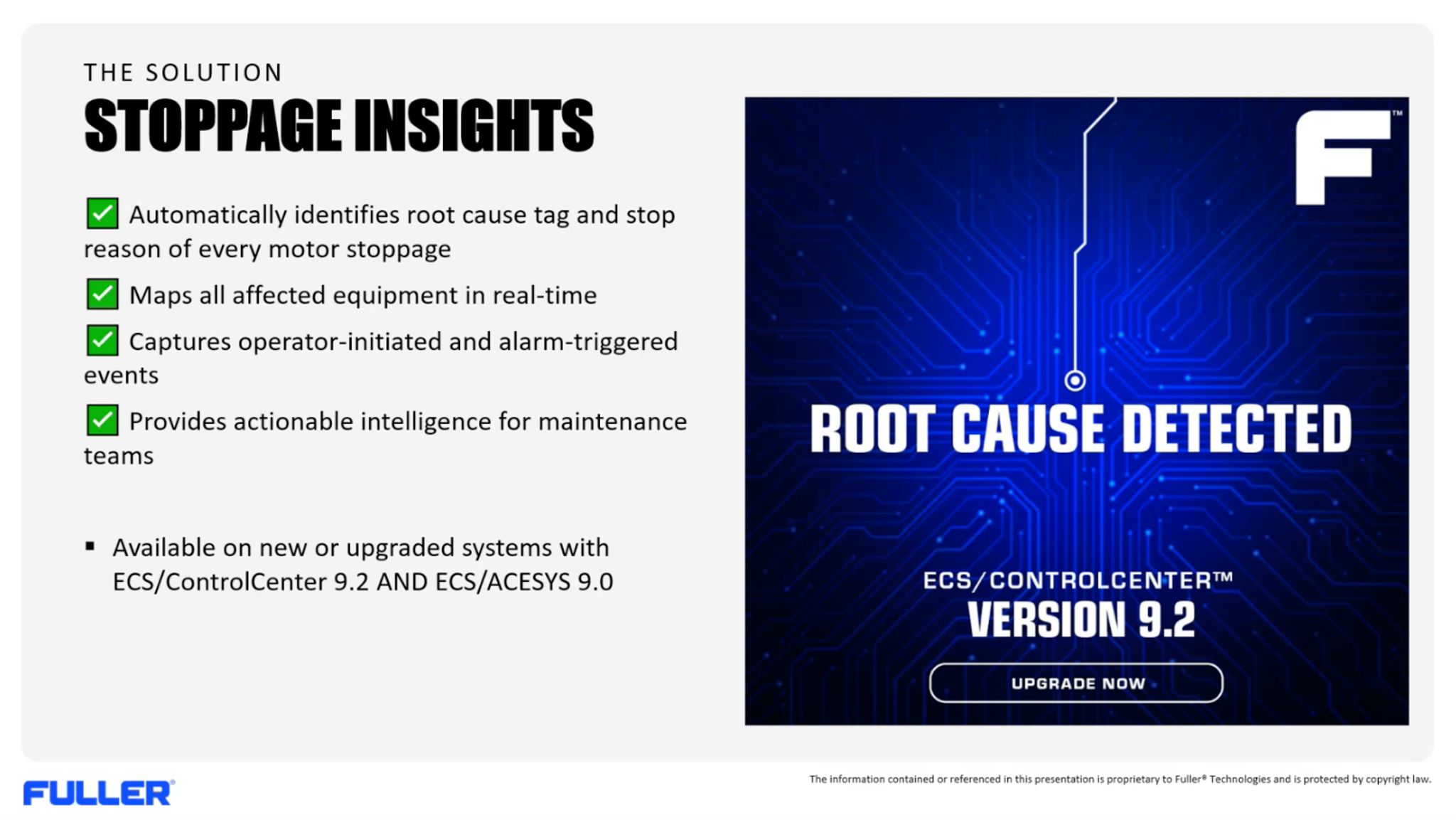
On one mill project, analysis found 48 different potential causes of a shutdown - which is why tracing a stoppage manually has always been slow, and why the knowledge to do it sits with a handful of veterans. Stoppage Insights runs automatically whenever a motor or controlled unit stops: it locates the root cause tag, identifies the stop reason, maps every affected unit in real time, and classifies the event as normal (operator or programmed sequence) or abnormal (an interlock triggered by a fault). A new Stoppages application covers the last 24 hours live and queries a year of history; a new tab on the motor faceplate shows that motor's stop history with reason, root cause tag, and cause - removing the routine of tracing interlocks from one faceplate to the next. It requires ECS/ControlCenter 9.2 and ECS/ACESYS 9.0 together.
Data Maintenance Teams Can Act On
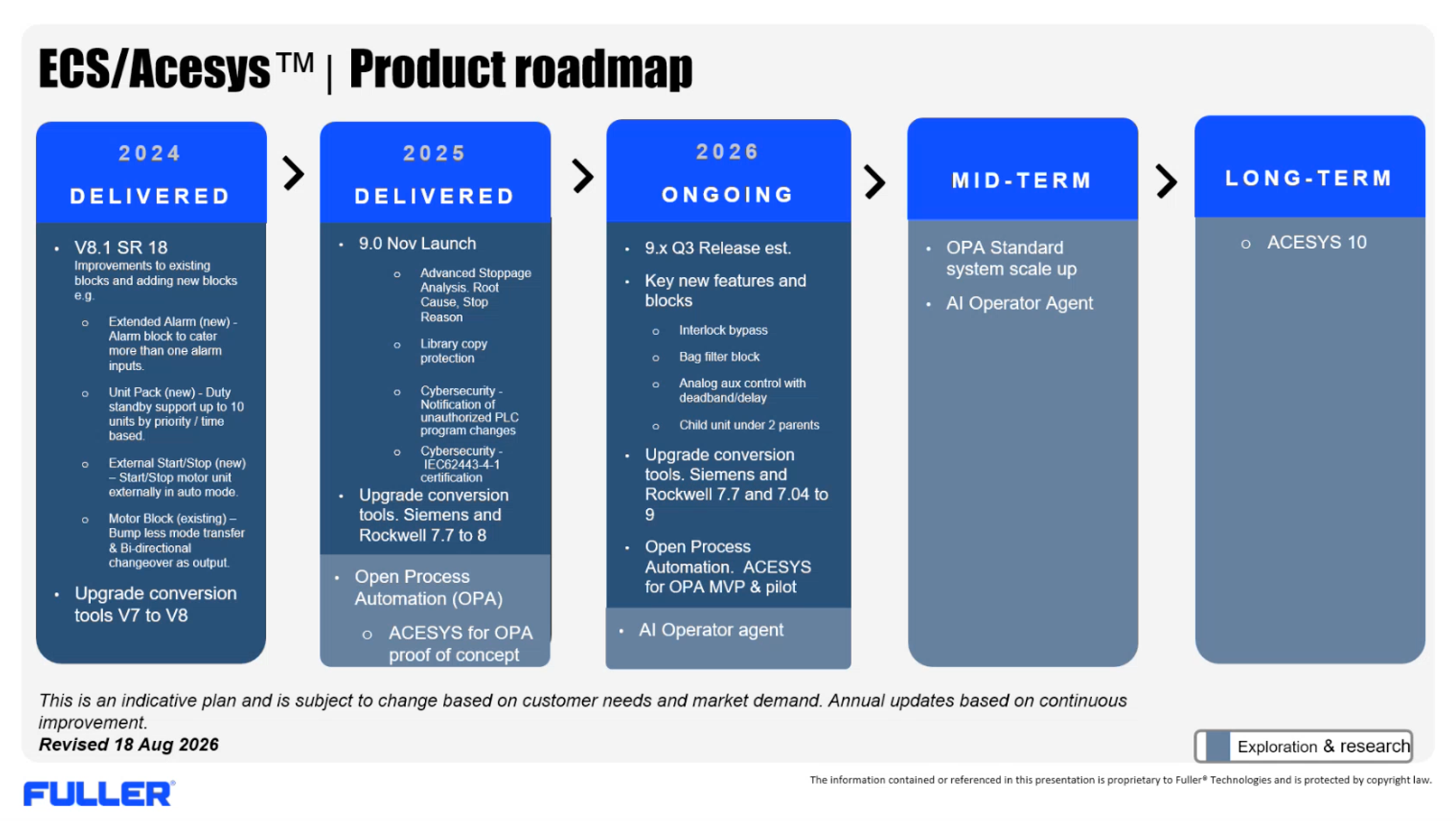
Detection is half the value; the record is the other half. Stoppage lists export to Excel with the affected point, state time, stop reason, kind, source point, and the full path from root cause to affected unit. The same data reaches CMMS, historian, and ERP through the ECS data export service, with MQTT Event Publisher streaming due in Q2 2027 and stoppages arriving in UptimeGo in 2027. Alongside this, ECS/ACESYS 9.0 adds multi-select blocks, interlock clusters, and other library improvements, while IEC 62443-4-1 certification and PLC program change monitoring - time-stamped events for any modification, with alarms for unauthorized changes - give plants an auditable answer to the Stuxnet-style scenario.
Process Interlocking View: Making Complexity Legible (2027)
Coming with ECS 9.3, the Interlocking View converts thousands of interlocks and startup dependencies into a structured map of the plant, updated in real time. These views are generated by the application rather than drawn by hand, in a web UI that zooms and pans like a mapping app. A flow diagram shows what can run in parallel and what blocks startup; a hierarchical tree shows where equipment sits and which group owns it. Together they answer what used to need a veteran: why will this equipment not start, what must happen before this area can run, what stops if this device trips. It is built on the Stoppage Insights data model - where one finds the root cause, the other explains the relationships behind it.
Open Process Automation: Standardize the Standard, Not the Supplier
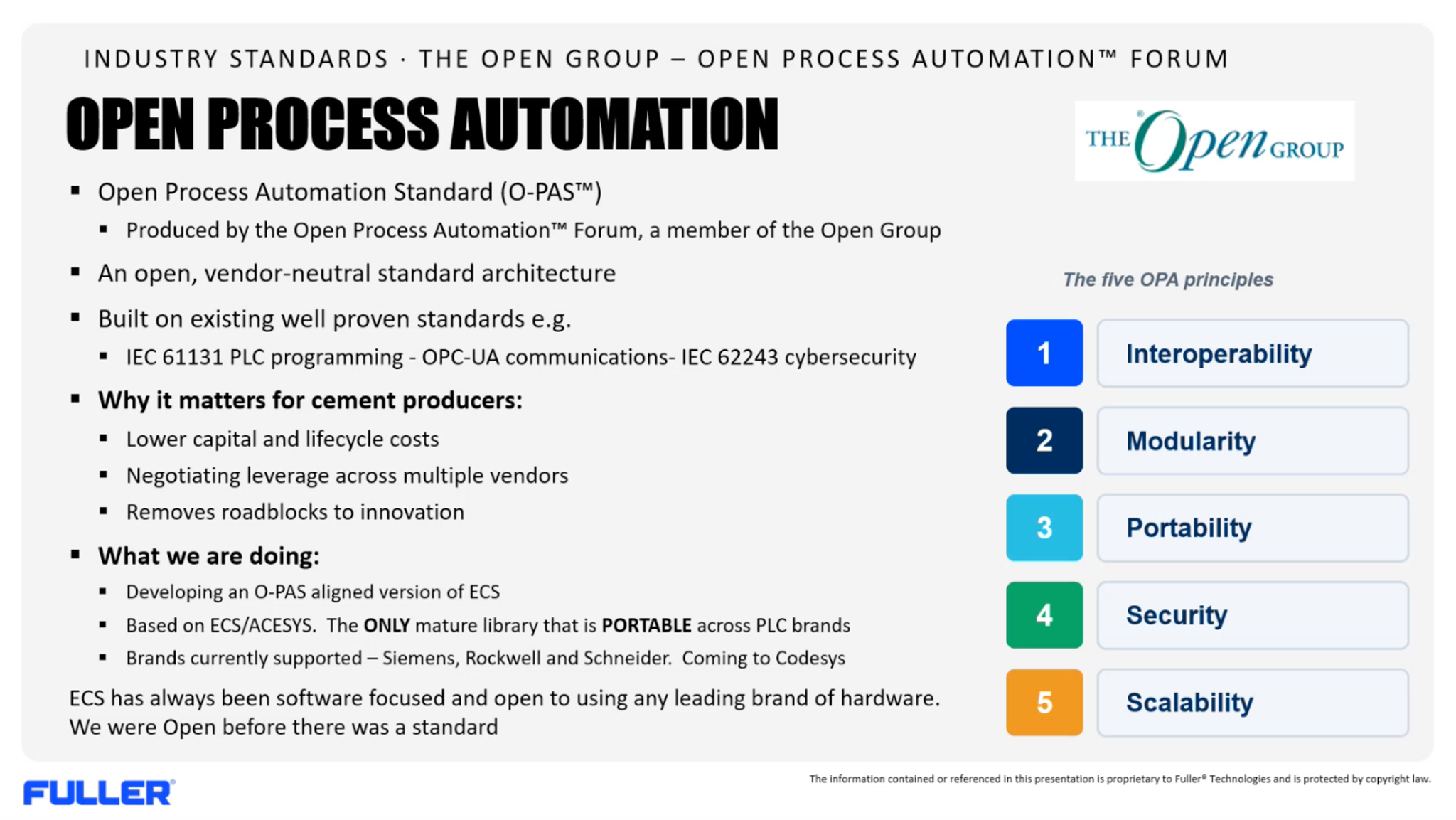
Many producers say they want one control standard across all plants - but in practice that usually means picking a main automation supplier and a PLC brand, which is not standardizing at all. O-PAS™, from the Open Process Automation Forum within The Open Group, offers the alternative: an open, vendor-neutral architecture built on proven standards including IEC 61131, OPC UA, and IEC 62443. Distributed control nodes decouple control software from hardware, a single OPC UA connectivity framework uses standardized data models, and gateways bring legacy DCS, PLC, and I/O into the architecture so brownfield plants avoid a rip-and-replace. Fuller is developing an O-PAS-aligned ECS based on ACESYS - the only mature control library portable across PLC brands, supporting Siemens, Rockwell, and Schneider, with CODESYS in development.
The Operator AI Agent: Veteran Knowledge, Inside the Safety Boundary
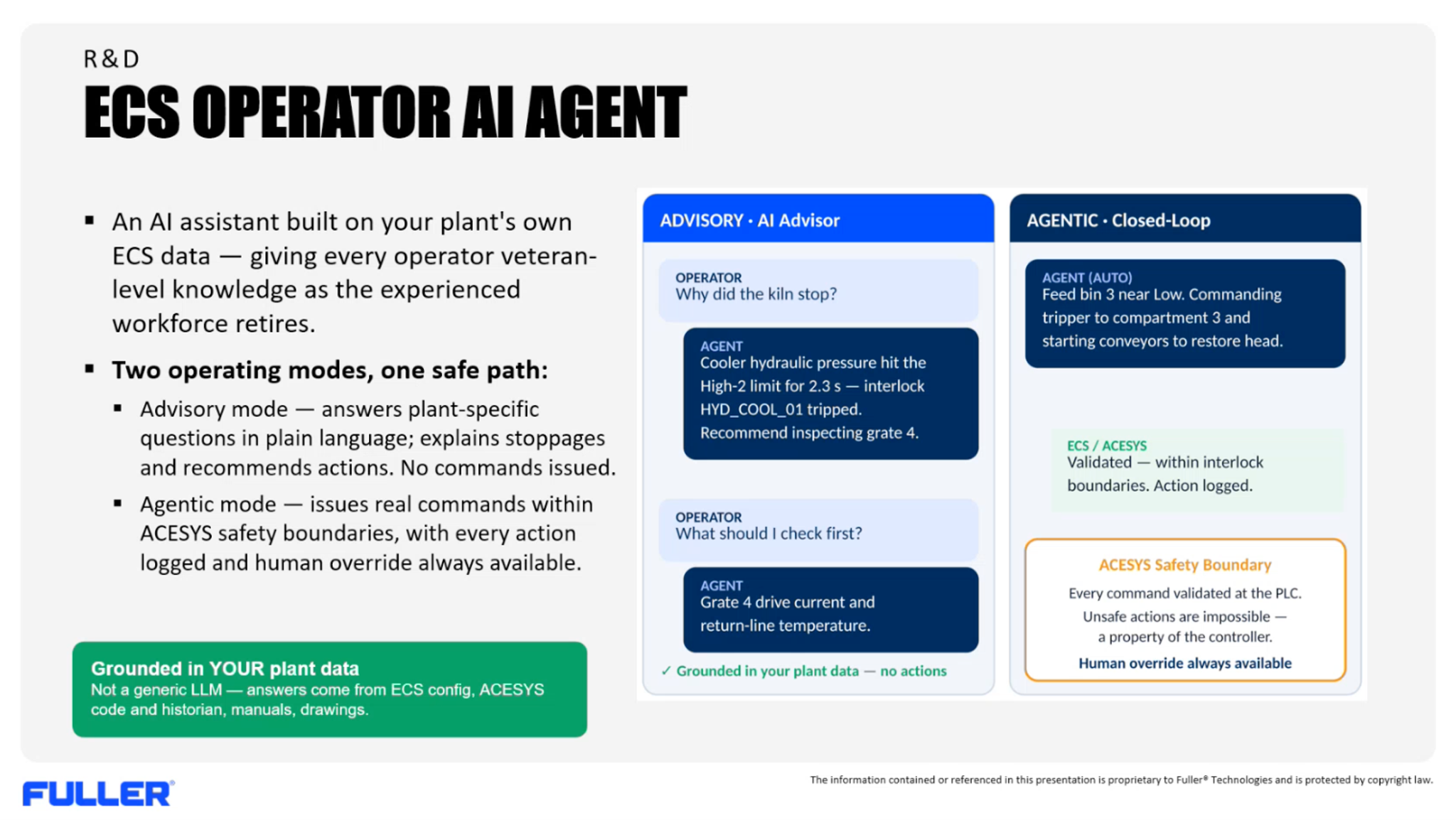
The Operator AI Agent is built on your plant's own ECS data - configuration, ACESYS code, historian, manuals, drawings - not a generic language model. Advisory mode, released first, answers plant-specific questions in plain language: it can explain that cooler hydraulic pressure exceeded its high-high limit and tripped an interlock, then recommend what to inspect. Where Stoppage Insights tells you what happened, the agent tells you what to do next. Agentic mode follows, with commands issued inside ACESYS boundaries, every action logged, and human override always available. Interlocks in the PLC act as an action mask, so an unsafe command is impossible - a property of the controller, not the AI - and role-based access grants command rights only once proven. Deployment follows the same logic as training a new operator: start with a simple department, extend as confidence grows.


See root cause detection in action
Watch the full session for the Stoppage Insights walkthrough, the Process Interlocking View prototype, and how ECS gets from automatic root cause detection to AI-assisted operations. Smarter and faster, with the foundation for the future of process control - it all starts at version 9.
Open, Grounded, and Safe by Design
The through-line of this session is that each layer makes the next one possible. ECS/ACESYS produces highly standardized, feature-rich programming - systems that are mostly configured rather than custom-written. That consistency is what lets Stoppage Insights trace a stoppage back through the hierarchy with no mapping work required, what the Interlocking View is built on, and what gives an AI agent something reliable to reason over. Most industrial AI projects fail on data wrangling; a year of well-structured ECS history removes that problem before it starts.
The same argument applies to openness. ECS has always been software-focused and open to any leading brand of hardware. Open Process Automation turns that posture into a standard others can be measured against - a shift that mirrors IT's move from proprietary mainframes to open computing. Reliability is not traded away for it; it remains the first requirement of any control system. And for producers weighing an upgrade, the roadmap is not a reason to wait: features arrive every year, the version 8 to version 9 path is deliberately easy, and a perpetual license with a software maintenance agreement adds future feature and OS updates at a discounted capital cost.
- David Campain, Global Product Lifecycle Manager for Process Control Systems, Fuller
Related Offerings




.png?w=1080&q=80&auto=format)